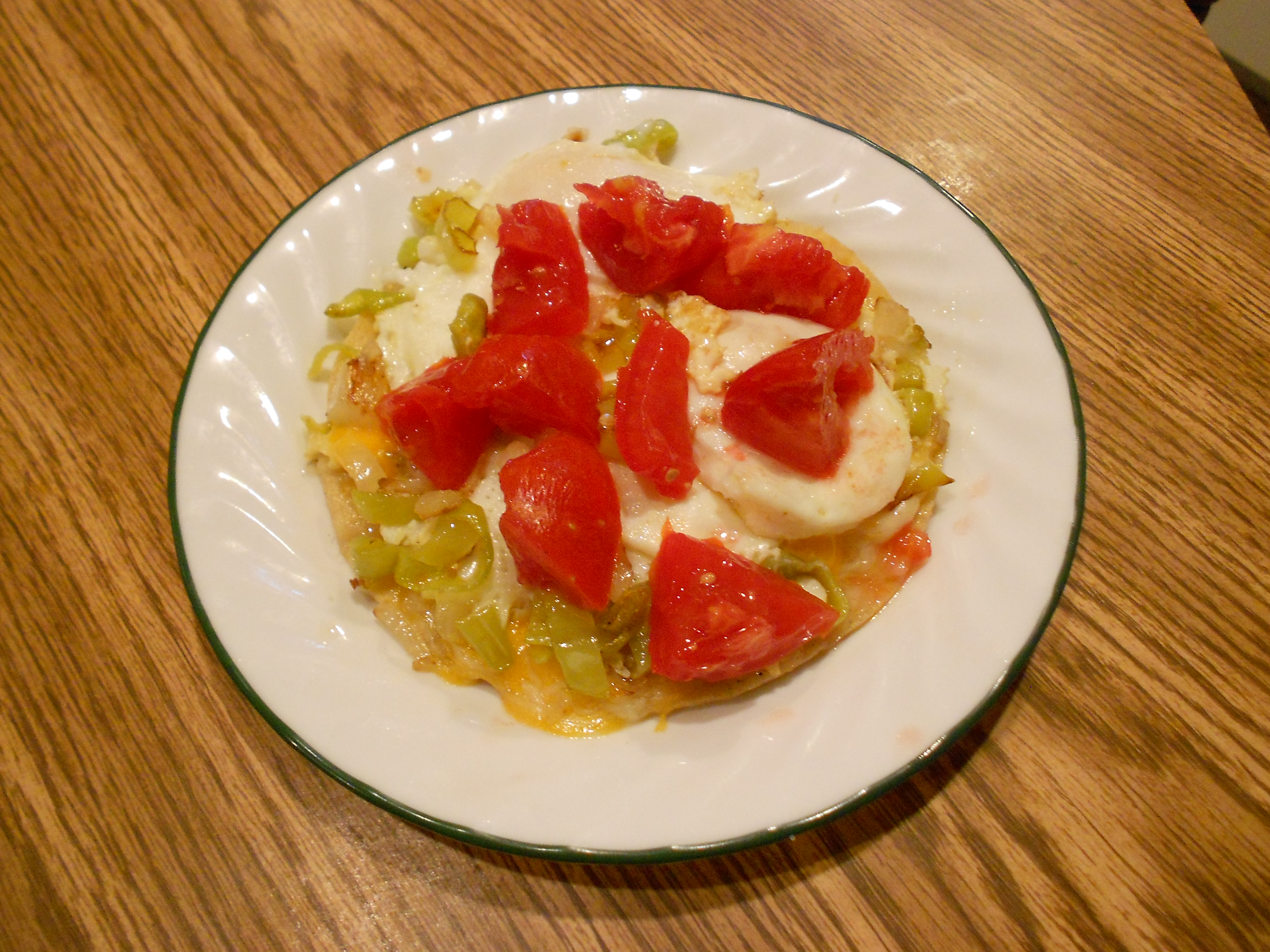
Many new low oxalate dieters are at a loss for what to eat for breakfast, especially if they used to eat a lot of whole grain toast or muffins. Corn tortillas may help fill this gap (2.5 mg. oxalate per “medium” tortilla). Tortillas can be eaten plain, with cream cheese, with Sunbutter or as the wrapping for a breakfast burrito. I especially like to make breakfast tostadas, especially in the summer or early fall when all of the veggies come fresh from my garden.
I admit my family is pretty boring when it comes to breakfast. We’ve adjusted well to mostly grain-free breakfasts. We eat eggs almost every day, occasionally with sausage or ham, occasionally with yogurt or coconut flour banana bread. Sometimes on a Saturday morning we like to dress things up and have Paleo pancakes, cottage cheese pancakes or these breakfast tostadas. I eat mine with lots of veggies. The boys eat theirs veggie-free with some fruit on the side. Breakfast tostadas are very versatile and can accommodate many dietary restrictions and variations. I rarely make mine the same way twice.
Here’s one low oxalate combination that I especially enjoy.
Breakfast Tostadas
2 corn tortillas (7 or 8 inch)
1 T cooking fat or your choice (I use lard, butter or olive oil)
2 ounces shredded cheese of your choice
1/4 cup chopped onion
1/4 cup chopped red pepper
1 T fresh chopped fresh cilantro
Pinch cayenne pepper
4 eggs
1/2 cup low oxalate tomato such as big beef (1/2 inch dice)
plain yogurt or sour cream for a garnish
Warm the corn tortillas in a medium-sized skillet with oil over medium low heat. Flip tortillas as soon as they become pliable (tongs work well for this) and add 1 ounce shredded cheese to the top of each. Put the lid on and cook for about 1 min. Remove the tortillas and set aside on two plates. Add the onions to the skillet and let sweat for 1-2 minutes. Add the peppers and cook another 1-2 minutes. Add the cilantro and cayenne pepper. Push the veggies to the side of the skillet and crack in four eggs for over easy or over medium eggs (alternately, you may scramble them). Put the lid on and let eggs cook for about 3 minutes until the eggs are set on bottom but still runny on top. Separate eggs with a spatula and flip. Cook for another minute or two to desired yolk “doneness.” Top each cheesey tortilla with two eggs and half the veggies. Add the tomatoes and garnish with a dollop of plain yogurt.
Serves 2
Note: This is my one skillet method for making one or two breakfast tostadas. If you are making breakfast tostadas for a crowd you might want to use 2 – 3 skillets and cook the tostadas separately from the veggies and eggs, so that everyone’s tostada is done about the same time.
Veggie Variations: You may use any combination of low oxalate veggies that you wish. I also really enjoy these with zucchini or yellow squash, dino kale, garlic, green chilis, sweet banana peppers, and shredded lettuce (raw). You may want to try other low oxalate herbs, too, such as basil. I tend to use whatever is fresh in the garden at the time.
Dairy-free: Simply leave out the cheese and garnish. You may also want to use three eggs instead of two if you want your breakfast to be more filling.
Low Oxalate Info: All the ingredients in breakfast tostadas are low oxalate as long as you choose a low oxalate tomato variety such as big beef or pink girl (early girl, German Johnston, brandy wine and yellow pear all have less than 6 mg. oxalate per half cup and also work well in this recipe). Breakfast tostadas have about 6.7 mg. oxalate per serving when using big beef tomatoes.
Other Diets: Breakfast tostadas may also be appropriate for gluten-free and vegetarian diets. They also may be appropriate for dairy-free and GFCF diets with modifications.

{ 7 comments… read them below or add one }
What corn tortillas are we supposed to use? I’ve seen white corn and yellow corn ones at the store and wasn’t sure which ones were lower oxalate?
Thanks for your question, Ryan.
Unfortunately, we don’t know what brand of tortilla was tested or whether it was a white corn or a yellow corn tortilla. All we know is that it was described as “medium – sized,” that it had 2.5 mg. oxalate per tortilla, and that the research scientists who reported the value in the scientific literature used testing techniques with enough scientific rigor to pass Dr. Michael Liebman’s review before being published in the VP Foundation’s low oxalate cookbook. Most of us agree that “medium” means a 7 inch tortilla – the standard size you find in most grocery stores and about the size most Mexican cooks would make for their families. It was also most likely a white corn tortilla that was tested. We know that ground yellow corn meal has 26.2 mg. oxalate per half cup while white corn mesa has 9.6 mg. oxalate per half cup. If I had to bet, I would say it was a white corn tortilla that tested at 2.5 mg. per tortilla (about what mine would be if I made them from scratch with white corn mesa).
Sorry for the confusion. I’ll specify white corn tortilla next time
Thanks!
Hello, I have just discovered your site, and I first want to thank you for all of your hard work and dedication. I recently had a bout with kidney stones (calcium) and never, ever want to experience that intense pain again. I was also recently diagnosed with osteoporosis. Trying to develop a proper diet plan has been difficult because I also have hypothyroidism. I am trying to stick to a low oxalate high alkaline diet, and I finally believe I can now accomplish that due to your site. There is just so much conflicting info on the web and in books about both types of diets. I have said no to the osteoporosis drugs and attempting to increase my bone density through diet, supplements and exercise. You have provided me with such wonderful information, and great recipes that I can use (with some slight modifications), but most of all you have given me hope. Thank you
I’m glad you found me, Liz! And thanks for letting me know that I’ve helped you. That makes me feel great!
Be sure to check out the Trying Low Oxalates Group. A number of members with hyperthyroidism have had vast improvements after a year or two on the LOD – it should help more than your kidney stone problem! You might also find members who are combining the LOD and a high alkaline diet, who can share recipes and ideas with you. Also, many people with osteoporosis can really benefit from a gluten-free or grain-free diet. You may want to research the connection and see if you think it might help you. Gluten-free diets often help people with oxalate issues, too, since many of us with oxalate issues have problems because of poor intestinal health (and the number one culprit for poor intestinal health in the typical Western diet is gluten). Anyway, this might seem like way too much for you right now, but it’s something to think about down the line.
Take Care and let me know if there are any types of recipes you are especially interested in.
I wanted to thank your website. I have been looking for something that gives me all the tools to try the oxalate diet and I found it useful and practical as I can see myself eating many of the recipes on your website.
I have not been diagnosed but I have all the symptoms of Vulvadynia and have been suffering for 7 years. NHS english doctors have been useless sending me from urology to gynecology, and dosing me on pain killers and antibiotics for what they say to be a urinary tract infection. I have been a guinea pig to so many types of antibiotics and know their diagnosis is not accurate but my urine, blood and swab testing has not come out with any results to treat me. I find it frustrating but recently (whilst desperately seeking help with the pain) Found the Vulvar Society website and since have decided on a diet change. I am a foodie and a strict diet will be a battle, but I am willing.
You said you symptoms decreased, I really hope the same will happen to me as every day I struggle with the pain. You have given the low oxalate diet. Before reading this I read the Acid-Alkaline diet which suggested that acidic products create the burning sensation. Many alkaline foods are low oxalate but I am unsure on a couple of ingredients. You do not dismiss red meat, whilst the other diets says this affects it, and tomatoes are a no no on the alkaline diet too.
But I will give this a shot and hope for the best. Thanks again!
Hi, Ayse.
I’m glad you found me. I hope the low oxalate diet helps you as much as it has helped me and thousands of other women. It really saved my life. Oxalate is known to cause severe burning sensations on the skin and tongue which is why Dr. Solomons guessed it might play a role in the burning pain associated with vulvar vestibulitis and vulvodynia and tried it with his patient–the first case study of a woman who healed her vulvar pain with a low oxalate diet. I found that when I was still in a lot of pain, acidic foods caused me a lot of grief. I don’t believe they caused the burning, but they made it a lot worse–like pouring lemon juice in an open wound. Ow! I avoided tomatoes, vinegar, and citrus fruits for the first few years I was on the low oxalate diet, then slowly added them back in. I don’t have any trouble with them now, but I didn’t eat anything acidic for years! I also took baking soda baths which helped a lot when I was still in a lot of pain.
Hope this helps.
Take care and good luck.